Open-architecture LabVIEW data acquisition software for FPAS pulse acquisition spectrometer systems. Full source code included.
Overview
The LaSpecMX (pronounced "Laze-spec") software was developed specifically for the FPAS-3216, FPAS-6416, and FPAS-0144 systems. Written in LabVIEW 2012, all source files, executable, and installer are provided — giving users full control to integrate and extend the software as needed.
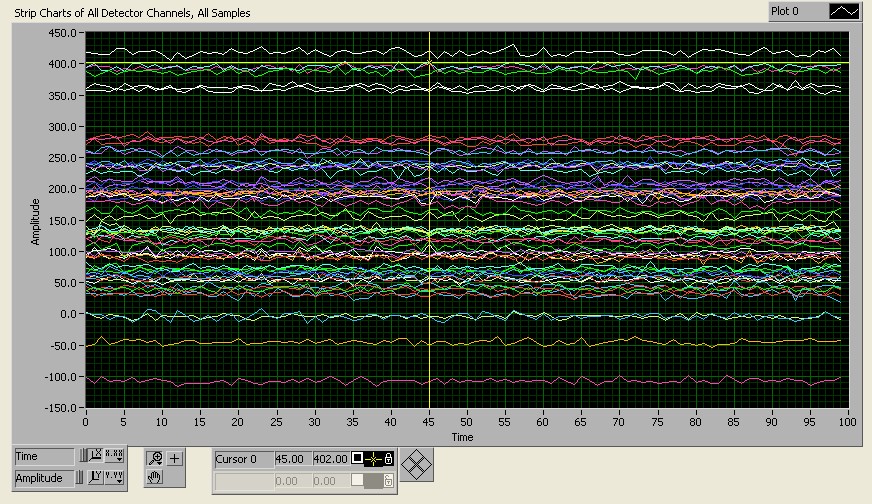
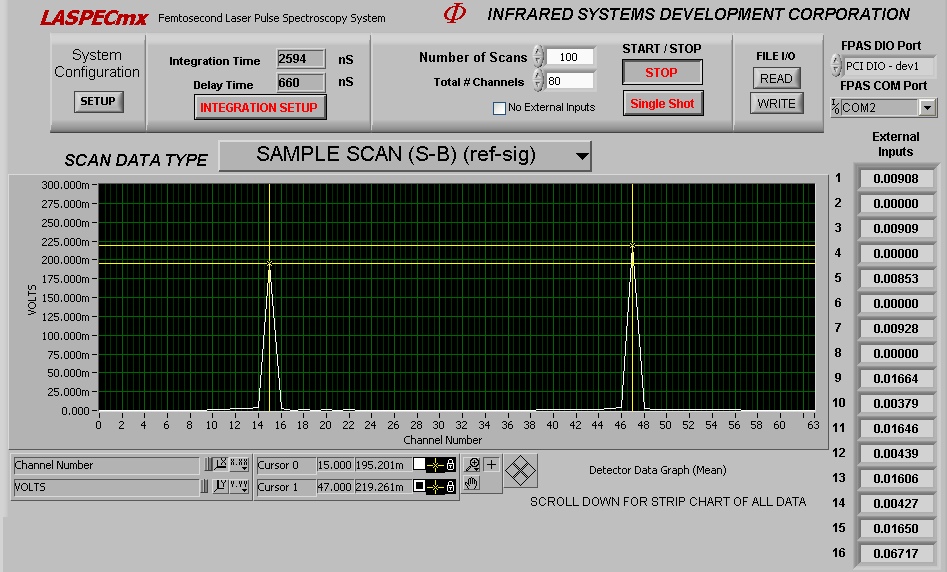
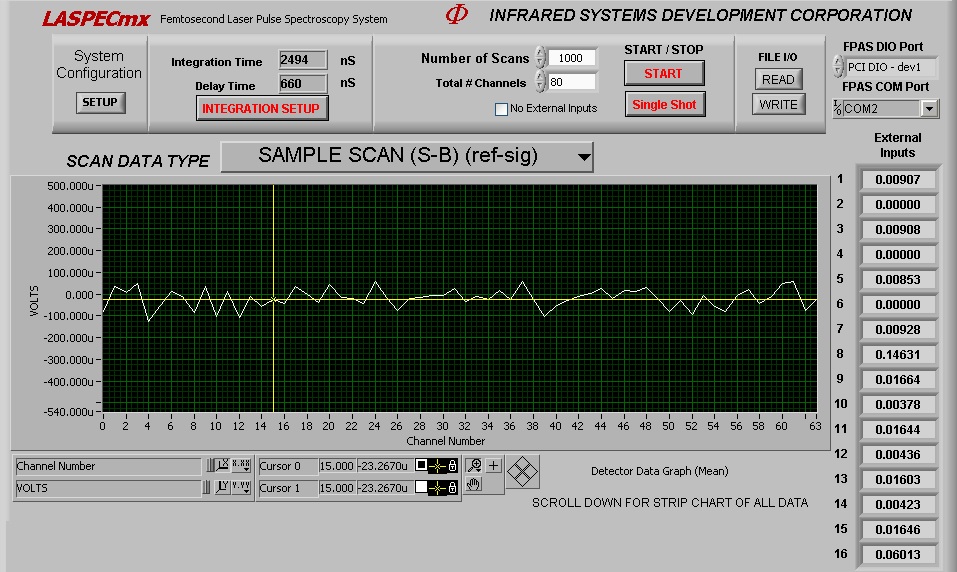
The main screen presents data gathered from the detector array, with external input values listed to the right of the main graph. All values are scaled to 5-volt levels.
Compatible Systems
Key Capabilities
Technical Data
| Laser Pulse Repetition Rate | 0 – 125 kHz |
| Integration Time | Adjustable in steps from 50 to 5,100 ns |
| Integration Delay | Adjustable in steps from 50 to 1,200 ns |
| Integrator Type | Boxcar type — low-noise, current-steering, auto-reset integrator |
| Photoconductive Amplifier | HgCdTe (MCT) — Low-noise 10 MHz amplifier with bias |
| Photovoltaic Amplifier (InSb) | Low-noise FET 5 MHz amplifier with zero-volt bias |
| Photovoltaic Amplifier (PVMCT) | HgCdTe (PVMCT) — Low-noise 10 MHz amplifier with zero-volt bias |
| A/D Conversion | 16-bit, ±5 V input, multiplexed 16 channels per A/D converter |
| Maximum Scan Storage | 1,000,000 complete scans of all channels |
| FIFO Memory | 1024 × 16 FIFO |
| Data Communications | FIFO read out via 20 MHz digital communications port |
| Typical Signal Level | ~7 V from 80 fs laser at 7 µm |
| Equivalent Input Noise | <1.5 nV/√Hz |
| System Signal-to-Noise | >>100 dB (100,000:1) at 1,000 scans p-p |
| Digital Noise | ±½ LSB |
| Typical System Noise | ±2 LSB rms (1,000 scans @ 2 kHz laser rep rate) |
| Digital Dynamic Range | −32,767 to +32,767 (16-bit, 65,535 counts) |
| Analog Dynamic Range | −5 V to +5 V |
| Software Platform | LabVIEW 2012 (source code, .exe, and installer provided) |
Software Features
Records the residual detector signal level with no laser power applied — establishes the baseline for all other scan modes.
Captures full laser power with no sample present, representing the 100% transmission baseline.
Measures the difference between the background and the sample signal for direct absorption measurement.
Divides sample data by the reference data; a value of 1 indicates maximum transmission (100%).
Uses a chopper in the optical path with the sync signal connected to External Input #16. Software phase-locks acquisition to alternate between reference and signal data points for improved noise rejection.
Subtracts residual DC levels from all external input channels, eliminating offset errors from the acquired data.
LaSpecMX is included with every FPAS system purchase. Contact us to learn more about FPAS configurations or to request a quote.